
Introduction
As the world faces increasing environmental challenges, from plastic waste to excessive carbon emissions, industries everywhere are searching for smarter, cleaner ways to make products. Traditional manufacturing methods often rely on mass production, material waste, and long-distance shipping — all of which harm the planet.
But there’s a quiet revolution happening in workshops and studios across the globe: 3D printing (also called additive manufacturing).
Unlike conventional methods that cut, mold, or shape raw materials, 3D printing builds products layer by layer with precision and minimal waste. At Crafty3DPrints.com, we’ve embraced this technology not just for creativity, but also because it represents a more sustainable way to make things — from custom decor to functional tools and prototypes.
Let’s explore how 3D printing is transforming the way we think about sustainability, manufacturing, and the future of design.
1. Traditional Manufacturing vs. 3D Printing: A Sustainability Check
To understand why 3D printing is such a game-changer, we first need to look at how traditional manufacturing works — and where it falls short.
Traditional Manufacturing
Conventional production methods like injection molding, CNC machining, or casting often:
- Require large quantities of raw material
- Produce scrap and waste during cutting and shaping
- Depend on bulk shipping and centralized factories
- Demand high energy consumption and tooling costs
All of these factors create a heavy environmental footprint — especially for small or customized production runs.
3D Printing (Additive Manufacturing)
By contrast, 3D printing:
- Builds objects layer by layer, using only the necessary material
- Allows local, on-demand production (no overseas shipping)
- Eliminates the need for molds or tooling
- Enables rapid prototyping with low energy use
The result is a leaner, greener, and more efficient process that aligns perfectly with modern sustainability goals.
2. Minimal Waste = Maximum Efficiency
One of the most powerful aspects of 3D printing is material efficiency.
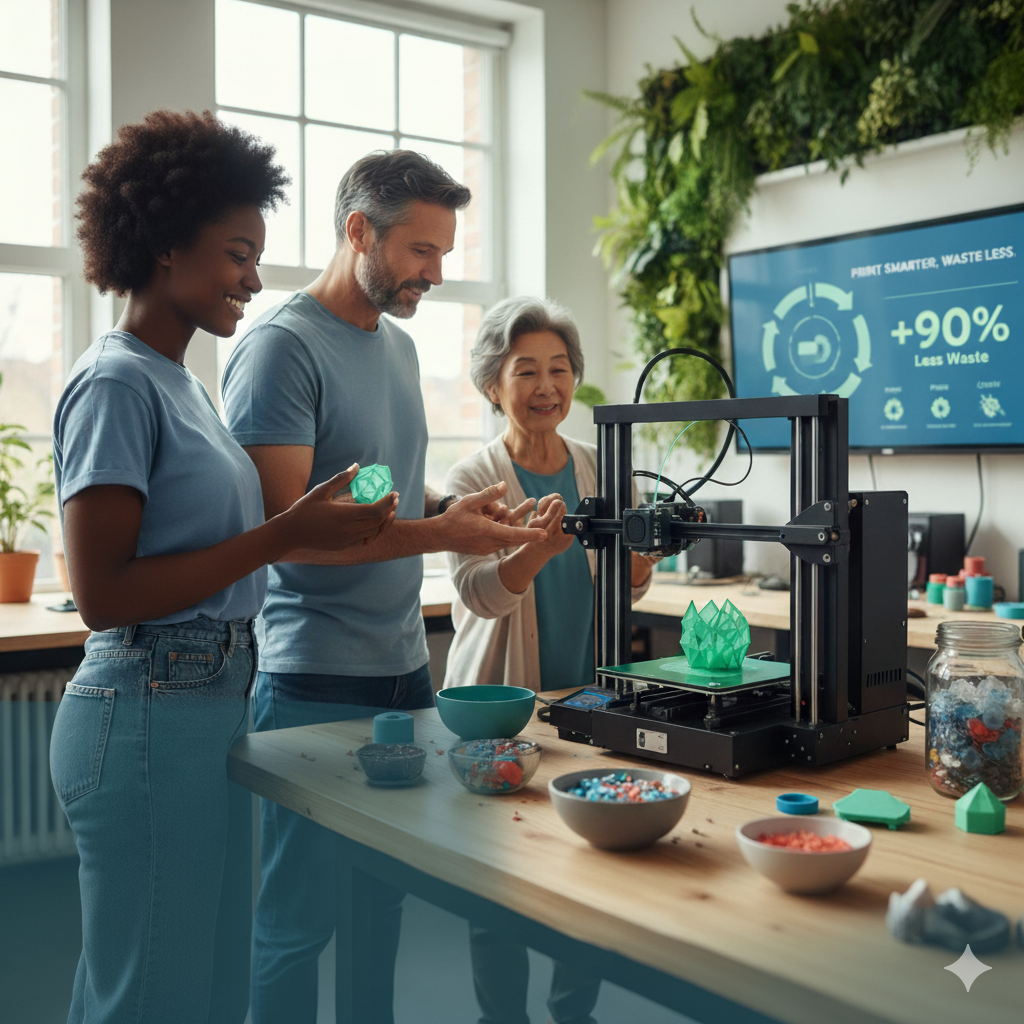
Traditional subtractive methods (like milling or cutting) often waste 60–80% of material. In contrast, 3D printing typically wastes less than 10%.
At Crafty3DPrints, we use PLA filament, a biodegradable plastic made from corn starch or sugarcane, making it both eco-friendly and durable.
How We Reduce Waste:
- Precise Material Control: Our printers use software to calculate the exact amount of filament needed for each print.
- Recycling: Failed prints or test runs are often recycled into new filament using specialized recyclers.
- Smart Design: We design products with lightweight honeycomb infills — reducing material use without compromising strength.
By optimizing every print, we ensure our process is both cost-effective and environmentally responsible.
3. Local Manufacturing: Reducing Carbon Footprints
Shipping and logistics are massive contributors to global CO₂ emissions. Most traditional products travel thousands of kilometers before reaching your desk.
But with 3D printing, the entire process can happen locally. Whether it’s a desk accessory, a model prototype, or a customized gift, we can design, print, and deliver everything from our Patiala-based studio — no overseas shipping, no warehouse waste.
Benefits of Local 3D Manufacturing:
- Cuts transportation emissions
- Reduces packaging waste
- Promotes local business ecosystems
- Supports faster delivery and better quality control
By producing locally, Crafty3DPrints is contributing to a more circular economy — where products are made close to where they’re used, not thousands of miles away.
4. Sustainable Materials: The Rise of Biofilaments
3D printing opens up a world of sustainable material options beyond petroleum-based plastics.
At Crafty3DPrints, we primarily use PLA (Polylactic Acid) — a biodegradable filament derived from renewable resources. Unlike traditional plastic, PLA breaks down naturally in industrial composting environments, reducing long-term pollution.
Other Eco-Friendly Materials in 3D Printing:
- Recycled PETG: Made from recycled water bottles.
- Wood-fill or Bamboo-fill PLA: Blends plastic with natural fibers for a wooden texture.
- Hemp-based filament: Strong, sustainable, and renewable.
- Algae-based filament: A new innovation that’s fully biodegradable.
These materials not only help reduce plastic waste but also give 3D printed objects a unique finish and feel that traditional methods can’t match.
5. Design Freedom = Longer Product Lifespan
Sustainability isn’t only about what materials you use — it’s also about how long a product lasts.
3D printing empowers designers to create more durable, repairable, and customizable products, reducing the need for constant replacements.
For example:
- A custom phone stand can be reprinted or upgraded easily.
- A broken part of a 3D printed lamp or holder can be reprinted individually — no need to throw away the entire product.
- Users can modify designs digitally before printing, ensuring perfect fit and function.
This flexibility encourages a “repair, not replace” mindset, which is key to reducing environmental waste.
6. On-Demand Production: No Inventory, No Waste
Traditional manufacturers produce thousands of items hoping they’ll sell. Unsold inventory often ends up discarded or burned.
3D printing flips this model upside down — everything is made on demand.
At Crafty3DPrints.com, we only print a product after a customer places an order. This approach eliminates:
- Overproduction waste
- Storage costs
- Dead inventory
It also allows us to offer limitless customization, since each item is printed specifically for the buyer — whether it’s a unique color, name engraving, or special size.
7. Sustainable Innovation in Every Industry
The sustainability impact of 3D printing goes far beyond consumer products. It’s reshaping entire industries:
Healthcare:
3D printed prosthetics and implants are customized for each patient — reducing medical waste and improving quality of life.
Construction:
Large-scale 3D printers can create eco-friendly houses using recycled concrete and local soil.
Aerospace & Automotive:
Lightweight 3D printed parts reduce fuel consumption and emissions.
Education & Research:
Schools and universities use 3D printing for low-cost learning tools, cutting down on disposable plastic models.
Every innovation in these fields brings us closer to a carbon-neutral future — and the lessons apply directly to consumer-level printing as well.
8. Recycling and Circular Economy
One of the most exciting sustainability trends in 3D printing is closed-loop recycling.
Imagine a future where every failed print, prototype, or broken product is ground down and reused to make something new — endlessly.
That’s not science fiction; it’s already happening. At Crafty3DPrints, we experiment with recycling PLA waste into fresh filament using compact recyclers. This process:
- Cuts down landfill waste
- Saves on raw material costs
- Keeps production local and circular
As this technology evolves, every 3D printing workshop could become a micro factory with zero waste.
9. Empowering Sustainable Entrepreneurship
3D printing isn’t just eco-friendly — it’s also economically sustainable.
Small businesses and creators can start manufacturing products with minimal investment, right from their home or office. That means less dependency on large factories, global shipping, or middlemen.
By enabling micro-manufacturing, 3D printing empowers entrepreneurs to:
- Create products responsibly
- Respond to demand instantly
- Keep production transparent and local
At Crafty3DPrints.com, we’ve seen customers transform simple ideas into successful small businesses — all powered by this sustainable model.
10. The Future: Green Printing + Smart Design
The next decade of 3D printing will merge AI-driven design, smart materials, and renewable energy to create a truly sustainable ecosystem.
We’ll see:
- Solar-powered 3D printers in rural areas
- AI optimizing print efficiency and material use
- Fully biodegradable prints that return to nature safely
Sustainability will no longer be a bonus — it will be the standard.
Conclusion
Sustainability isn’t about stopping production — it’s about rethinking how we make things. And 3D printing is at the heart of that change.
By using eco-friendly materials, on-demand production, and local manufacturing, 3D printing drastically reduces waste, pollution, and energy use — while empowering creativity and innovation.
At Crafty3DPrints.com, we’re proud to be part of this movement. Every custom lamp, organizer, or model we print is a small step toward a cleaner, smarter, and more sustainable future.
? Whether you’re a business owner, designer, or eco-conscious buyer — join the revolution. Let’s build a greener tomorrow, one layer at a time.
? Explore sustainable, custom-made 3D prints at Crafty3DPrints.com