Introduction
Every great invention begins as an idea — a spark of imagination that grows into something tangible. With the evolution of 3D printing, turning ideas into real, usable objects has become faster, easier, and more accessible than ever before.
At Crafty3DPrints.com, we’ve helped countless individuals, designers, and businesses transform their sketches and concepts into physical models — from personalized gifts to professional prototypes. But how exactly does that happen? What’s the journey from a digital thought to a solid object you can hold?
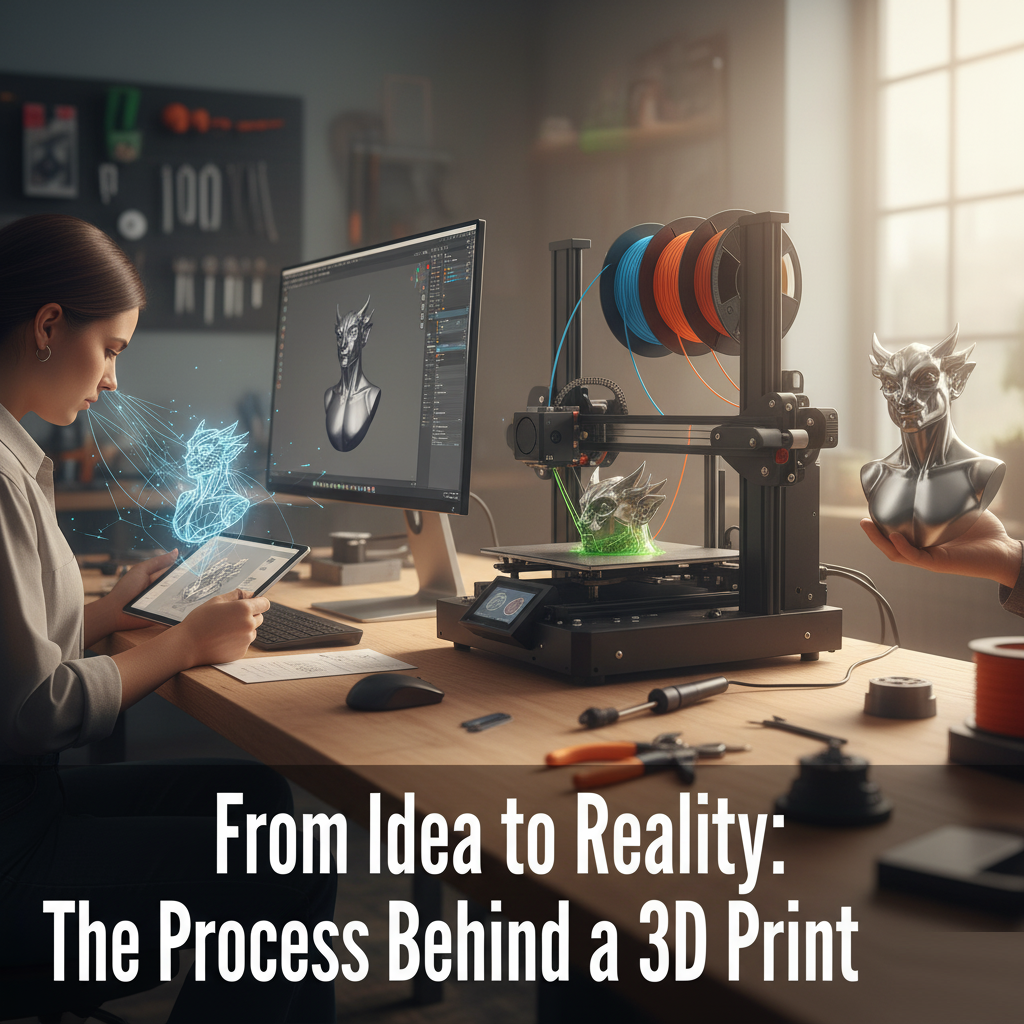
In this post, we’ll take you behind the scenes and explain the entire 3D printing process — step by step — so you can understand how your ideas come to life.
Step 1: It All Begins with an Idea
Every 3D print starts with imagination. You might have:
- A creative concept (like a custom keychain or desk accessory),
- A functional need (such as a replacement part or organizer), or
- A business design (like a product prototype or model).
Whether your idea is rough or refined, our team at Crafty3DPrints can help bring it to life. You don’t need advanced design skills — just a clear vision of what you want.
Some clients send hand-drawn sketches, while others share reference images or existing files. Whatever the input, the goal remains the same: turn that idea into a 3D model ready for printing.
Step 2: Designing the 3D Model (CAD Stage)
Once the idea is clear, it’s time to design it in a 3D modeling software like Blender, Fusion 360, or TinkerCAD.
This step, known as CAD (Computer-Aided Design), is where the object takes digital shape. It involves creating every curve, hole, and surface with precision.
At Crafty3DPrints, our design team ensures:
- The model is dimensionally accurate
- It’s optimized for 3D printing (no floating parts or weak points)
- The file is compatible with printing software (usually in .STL or .OBJ format)
If you’re not familiar with CAD, don’t worry — that’s part of what we do. You can simply describe your idea, and we’ll create the printable 3D file for you.
Step 3: Slicing – Preparing for Printing
Once the 3D model is ready, it needs to be translated into a language the printer can understand. That’s where slicing comes in.
Using slicing software like Cura or PrusaSlicer, the digital model is divided into hundreds or thousands of thin horizontal layers. The slicer also generates G-code, which instructs the printer exactly how to move, what temperature to maintain, and how much material to use.
During slicing, we fine-tune several important parameters:
- Layer height (affects print resolution)
- Infill density (affects strength)
- Print speed and support structure
- Material type (PLA, PETG, ABS, etc.)
At Crafty3DPrints, we carefully balance quality and speed, ensuring the final print looks great and performs well.
Step 4: Printing the Model
Now comes the exciting part — turning the digital model into a physical object.
We use FDM (Fused Deposition Modeling) technology, one of the most reliable and widely used 3D printing methods. Here’s how it works:
- The printer heats a filament (plastic) to its melting point.
- The material is extruded layer by layer, following the G-code instructions.
- As each layer cools, the next one builds on top, gradually forming the complete shape.
Depending on size and complexity, printing can take anywhere from 30 minutes to several hours.
Throughout the process, our printers are monitored for temperature stability, adhesion, and accuracy — ensuring consistent, high-quality results.
Step 5: Removing and Inspecting the Print
Once printing is complete, the object is carefully removed from the build plate. This step requires precision to avoid damaging delicate parts or details.
At this point, we conduct a visual and dimensional inspection to check:
- Layer alignment
- Surface finish
- Structural integrity
If a part doesn’t meet our quality standards, we reprint or adjust the settings. Every product at Crafty3DPrints.com is held to a strict standard of accuracy and finish.
Step 6: Post-Processing and Finishing Touches
Freshly printed 3D objects may have small imperfections or rough surfaces. That’s where post-processing comes in. Depending on the project, this can include:
- Support removal (trimming away extra plastic)
- Sanding (for smoother surfaces)
- Painting or polishing
- Assembly (if the model has multiple parts)
For example, a Mini Moon Lamp goes through detailed sanding, fitting of light components, and final surface treatment to achieve a clean, premium look.
We also offer color finishing and coatings on request, making your 3D print look and feel more professional.
Step 7: Quality Check and Delivery
Before shipping, every product undergoes a final inspection to ensure it matches the design, dimensions, and durability expected by the customer.
Once approved, it’s carefully packaged and delivered right to your doorstep — ready to use, gift, or display.
Our clients love how simple and transparent this process is. From concept to completion, they stay updated at every stage.
Why Understanding the Process Matters
Knowing how 3D printing works helps customers appreciate the value of craftsmanship and technology involved in each print. It’s not just about pressing a button — it’s about:
- Designing with precision
- Calibrating machines
- Selecting the right materials
- Ensuring strong, beautiful results
At Crafty3DPrints, we treat every project — big or small — with the same level of care. Whether it’s a single prototype or a batch of custom gifts, we make sure every print reflects professional quality.
Materials Matter: Choosing the Right Filament
The type of filament used in 3D printing affects strength, texture, and finish. Here are some common materials we work with:
- PLA (Polylactic Acid): Eco-friendly, biodegradable, great for decorative items and gifts.
- PETG: Durable, slightly flexible, and heat-resistant — ideal for functional parts.
- ABS: Strong and tough, used for industrial or mechanical components.
- TPU: Flexible material for shock-absorbing products like grips or phone cases.
By matching the material to your purpose, we ensure your print performs exactly as intended.
Common Myths About 3D Printing
Many people still believe 3D printing is slow, expensive, or just for professionals. Let’s clear that up:
- Myth 1: “3D printing is only for engineers.”
→ Fact: Anyone can design and print with guidance. - Myth 2: “It’s too costly.”
→ Fact: On-demand printing often costs less than traditional manufacturing. - Myth 3: “The quality isn’t good enough.”
→ Fact: Modern printers deliver professional-grade accuracy and finish.
At Crafty3DPrints, we’ve made 3D printing affordable and accessible for everyone.
Applications: Beyond Gifts and Gadgets
The process you just read about isn’t limited to personal items — it’s revolutionizing multiple industries:
- Education: Creating learning models for science and engineering.
- Architecture: Producing miniature building prototypes.
- Healthcare: Printing assistive tools and prosthetic models.
- Manufacturing: Rapid prototyping and spare part production.
Our ability to print both decorative and functional items means there’s almost no limit to what you can create.
Conclusion
From concept to creation, the 3D printing process is a beautiful fusion of imagination, design, and technology. It gives everyone — from individuals to innovators — the ability to make their ideas real.
At Crafty3DPrints.com, we’re passionate about turning those ideas into precision-made products that inspire and solve real problems. Whether you’re envisioning a personalized gift, a custom home accessory, or a prototype for your next invention, we’ll guide you every step of the way.
? Visit Crafty3DPrints.com today and see how we can help you turn your ideas into reality — one layer at a time.